What to Know When Specifying a Custom Power Transformer

Ever received a quote for a custom power transformer that looked right on paper, then got a part that ran hot? Or didn't fit the enclosure? The specification was probably missing something.
Custom transformer design needs information catalogue selection never asks for: ambient temperature, enclosure type, duty cycle, load characteristics. When that information isn't provided upfront, a manufacturer makes assumptions. Some assumptions are safe. Others aren't, and you won't find out which until the part is in your hands.
Getting a custom power transformer right on the first prototype isn't luck. It comes down to how complete your power transformer specification is before the design work starts.
Start With the Electrical Parameters You Already Know
Voltage and power ratings are the obvious starting point, but they're not sufficient on their own. A transformer spec needs primary and secondary voltage, rated power in VA or kVA, frequency, and tolerance on each. If your application involves multiple secondary outputs, list them all, including the current each one needs to deliver.
Current matters more than most engineers expect at the specification stage. A 100VA transformer at 10V output and one at 100V output are built completely differently. Secondary winding conductor sizing is driven by current, not power alone. Approximated current values are one of the more common causes of a first prototype that runs warmer than calculated.
Frequency is equally important and often listed as an afterthought. A transformer wound for 60Hz won't perform the same at 400Hz. Core material, number of turns, and window utilization all shift with operating frequency. If your application runs at anything other than the standard line frequency, say so up front.
The manufacturer can't design around a constraint they don't know exists. Duty cycle belongs here, too. A transformer at continuous full load has different thermal requirements than one cycling between full load and idle. If your load profile isn't constant, describe it.
Insulation Class Is a Design Decision, Not an Afterthought
Insulation class sets the maximum continuous operating temperature your transformer can handle. IEC 60085 classifies insulating materials from Class A at 105°C up to Class H at 180°C. Class B (130°C) and Class F (155°C) are the most commonly specified in industrial applications.
Underspecifying means the insulation system degrades faster than expected under sustained load, which leads to premature failure. Overspecifying adds cost without benefit if the application never approaches the rated temperature ceiling.
To select the right class, calculate the expected winding temperature rise under full load and add your maximum ambient temperature. The insulation class needs to sit above that combined figure with enough margin for real-world variation. A transformer seeing 70°C rise in a 40°C ambient needs a system rated above 110°C. Class B at minimum, Class F if you want meaningful headroom.
Insulation class isn't determined by any single material. It requires the full system, including wire insulation, impregnation varnish, core insulation, and any potting compound, to be qualified together. Substituting one component for a supposedly equivalent material can invalidate the class rating entirely. If your application faces third-party safety approval, get the insulation system confirmed before the prototype is built, not after.
Operating Environment Shapes More Than the Enclosure
Installation environment feeds into almost every physical design decision. Temperature range, humidity, vibration, altitude, and contaminants all shape enclosure type, impregnation process, and terminal configuration.
A transformer for an offshore platform has different requirements than one going into a climate-controlled server room. Even if the electrical parameters are identical.
The offshore unit needs a sealed or conformal-coated design, vibration tolerance for a marine environment, and materials that resist salt-laden air. Specifying it as a standard industrial transformer will produce something that fails in service.
Altitude is worth flagging specifically because it's frequently omitted. At higher elevations, convective cooling is less effective. The dielectric strength of air gaps also decreases. Both affect how the transformer needs to be designed. IEEE C57.12.01 covers dry-type transformer requirements including altitude. If your installation sits above 1,000 metres, that belongs on the spec sheet.
Vibration tolerance, shock ratings, and ingress protection (IP) requirements belong on the spec sheet too, not assumed to be standard. A transformer on moving equipment or in wash-down environments needs those constraints built in from the start, not retrofitted after a failure.
Core Material Selection Follows from Your Application
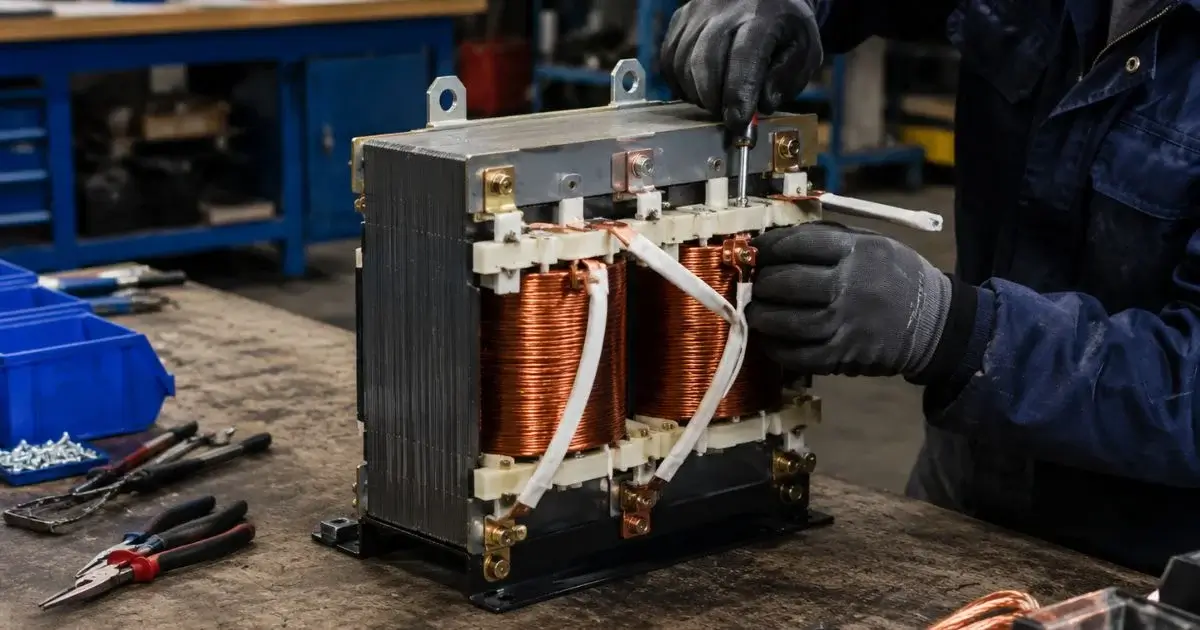
The magnetic core material is one of the most consequential design choices in a custom power transformer. It follows directly from operating frequency and application type. Get it wrong, and you'll see higher losses, excess heat, or a unit that's physically larger than your design allows. Different materials have different loss profiles, saturation characteristics, and cost points.
Grain-oriented electrical steel laminations are standard for 50Hz and 60Hz applications. They're well-understood, widely available, and cost-effective at those frequencies. As frequency climbs into the kilohertz range, core losses in laminated steel become prohibitive. Ferrite or powdered iron cores become the practical alternative.
Amorphous metal and nanocrystalline cores sit between those two ranges. They offer significantly lower losses than standard laminations at power frequencies, useful where efficiency and heat generation are tightly constrained. How these trade-offs play out across application types is covered in more detail on the core material selection page.
Don't leave core material selection entirely to the manufacturer if your application has specific efficiency or size requirements. If losses need to stay below a certain threshold, or the transformer has to fit a defined footprint, say so. That's useful design input, not micromanagement. A manufacturer with a broad design history has usually seen something close before, which shortens the iteration cycle.
Mechanical Requirements Are Part of the Specification
Physical constraints are often the last thing added to a transformer specification. They're also the first thing that causes a prototype to fail a fit-and-function review. Include mounting configuration, maximum dimensions in all three axes, weight limits if they apply, and terminal type. If the transformer needs to fit inside an existing enclosure, provide those dimensions and the clearance available around the unit. Getting this right on paper saves a full build cycle.
Terminal configuration is worth specifying explicitly. Lug terminations, flying leads, and PCB-mount pins aren't interchangeable at the assembly stage. If there's a preferred lead length, wire gauge, or connector type, put it in writing. Include any labelling requirements, polarity marking, or colour coding that your production process depends on.
Unusual pin spacing or high-current bus bar connections are achievable, but they need to be in the specification before tooling decisions are made.
Unusual mounting orientations like vertical core, inverted mounting, or integration into a larger assembly need to be noted. Some designs that perform within thermal limits in standard orientation run hotter when repositioned, because natural convection paths change.
Certification and Testing Requirements Belong on the Spec Sheet
In regulated industries, certification requirements for a custom power transformer can affect the design as much as the electrical parameters. For Canadian market access, CSA Group certifies dry-type transformers to the CSA C22.2 No. 66 Series under the Canadian Electrical Code. Energy efficiency is a separate requirement.
Federal Energy Efficiency Regulations set minimum efficiency standards for dry-type transformers sold in Canada. Single-phase units from 15 to 833 kVA and three-phase units up to 7,500 kVA fall within the scope.
For US market access, CSA Group is recognized by OSHA as a Nationally Recognized Testing Laboratory (NRTL). That means a cCSAus mark carries equivalent weight to a UL mark.
Most manufacturers distributing across both markets specify dual certification upfront. If your product also requires CE marking, that needs to be in the design brief before engineering begins.
Application-specific standards add another layer. Aerospace magnetics may carry MIL-PRF-27 requirements. Medical applications can require additional isolation and leakage current testing. Nuclear qualification follows IEEE Std 638. None of these are parameters a manufacturer can design in retroactively.
Testing requirements deserve their own line on the spec sheet. Dielectric strength testing, partial discharge testing, temperature rise testing under load, and environmental testing all exist when specified. They aren't automatically included in every production build.
If your incoming inspection or qualification process requires a specific test, confirm it's in the quote scope. The testing and quality assurance process for custom magnetics covers what these tests involve and when each one applies.
Electronic Craftsmen has worked through this specification process across aerospace, marine, medical, and industrial applications for nearly seven decades. The design database built across those projects means that even unusual requirement combinations usually have a precedent to draw from. More detail on what that process looks like is covered in the behind-the-scenes quoting and prototyping overview.
If you're ready to start, Electronic Craftsmen's engineering team can review your requirements and return a ballpark estimate within one to two business days. Use the one-page specification checklist to pull the key parameters together, or contact the team directly at [email protected].
The goal of a complete specification isn't to hand a manufacturer a finished design. It's to give them enough information that their assumptions stay small. Get the major parameters right up front, and the first prototype has a reasonable chance of being the last one you need.