How Weight & Reliability Define Aviation Inductor Design

Aviation is one of the few industries where a magnetic component's weight gets argued over in grams. Every gram on an aircraft has a cost in fuel, in payload, in certification margin. Reliability requirements are just as demanding.
A component that performs well in an industrial cabinet has a far easier life than one mounted in an avionics bay, cycling through temperature extremes and vibration loads every flight. Aviation inductor design lives under both pressures at once, and decisions made early determine whether a component makes it through qualification or gets redesigned after the fact.
Those two pressures pull in opposite directions more often than not. Design choices that reduce mass often introduce trade-offs in thermal stability or mechanical durability. Getting both right requires a process that starts well before a core material gets selected, and for any aerospace power inductor, that process has to account for qualification requirements from the beginning.
Aviation Inductor Design Starts with the Right Core
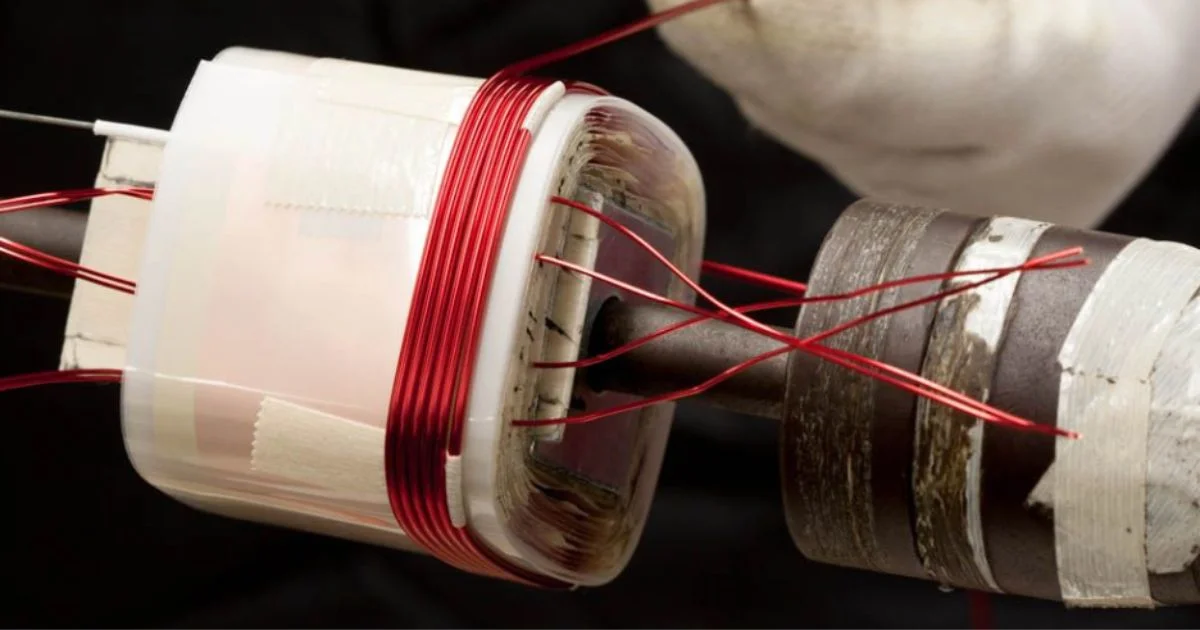
The inductor's core determines most of what follows. Choose the wrong material, and you're compensating everywhere else: in winding design, encapsulation, thermal management, and ultimately in mass.
Ferrite cores work well at higher switching frequencies because core losses stay manageable, and the geometry stays compact. But ferrite saturates under high DC bias, limiting its usefulness in filter inductors that carry significant DC current. When the core saturates, inductance drops, and the component can't do its job.
Nanocrystalline and amorphous strip-wound cores are where aviation designers often land for demanding applications. Their higher saturation flux density and permeability let you reach the same inductance in a smaller, lighter package. The trade-offs are cost and lead time, but they matter less in aviation programmes than in commercial electronics.
Powdered iron handles DC bias better than ferrite and tolerates overloads without hard saturation. Higher core losses at elevated frequencies make it a poor fit for high-frequency switching, but it is commonly used in line-frequency filter designs where that trade-off is acceptable.
Understanding how inductors, chokes, reactors, and filters differ matters here because the right core material depends on the function the component serves in the circuit.
Aviation's 400Hz Power Architecture Changes Everything
Commercial and military aircraft use 400Hz inductor applications — not the 50 or 60Hz standard used in ground-based equipment. That single fact has real consequences for inductor design. MIL-STD-704F is explicit about it: equipment designed for military aircraft shouldn't use 60Hz because it requires more weight and prime mover capacity per unit of power consumed.
That trade-off between frequency, component size, and weight is exactly why aircraft moved to 400Hz in the first place. At 400Hz, core losses are higher for a given material than they'd be at lower frequencies, and that gap widens as you push further up. A silicon steel lamination core that handles 60Hz without issue runs into thermal problems at 400Hz, which is why material selection isn't a secondary decision.
This is one reason why 400Hz inductor design pushes toward materials that hold low losses at higher frequencies. Nanocrystalline and amorphous materials show up so often in aviation magnetics precisely because they were developed to address this problem.
The 400Hz architecture also means inductors can be physically smaller for a given inductance value. That's a weight benefit, but it requires tighter control over core geometry and winding layout to realize without introducing new loss mechanisms.
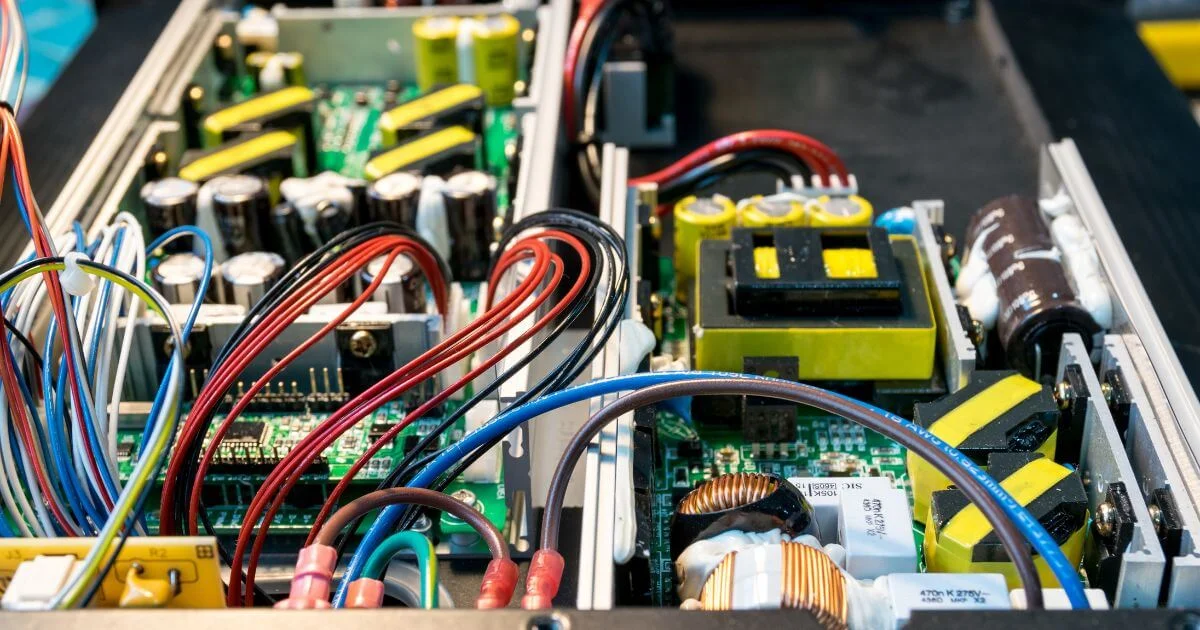
DC-DC converters in avionics run at much higher switching frequencies. At those frequencies, skin-effect losses in the winding become a significant concern. Litz wire, a conductor made of many individually insulated strands twisted together, reduces those losses by spreading current across a larger effective conductor area.
It's more expensive and harder to terminate reliably than solid wire, but the alternative is a heavier winding or a larger core. Both cost more in the weight budget than the wire does.
What MIL-PRF-27 Actually Demands
MIL-PRF-27 is the governing specification for power transformers and inductors in military and aviation applications. For a MIL-PRF-27 inductor, Grades 5 and 6 cover the most demanding environments. What the spec requires goes well beyond electrical performance at room temperature.
Dielectric strength testing checks that the insulation system holds up under voltage stress that is representative of real service conditions. In high-voltage applications, this includes partial-discharge testing, which detects localized breakdown in small voids within the insulation. A standard hipot test will pass a component that has minor voids.
Partial discharge testing catches what hipot doesn't, because those voids cause insulation to degrade gradually. It won't show up on a bench. It shows up as a field failure after the component has been in service long enough for the damage to accumulate. Thermal performance requirements reflect the conditions that aviation components experience.
Thermal cycling from -34°C to +190°C represents the spread between a cold-soaked component on a winter ramp and a fully loaded avionics bay at operating temperature. A component that drifts outside acceptable limits at either extreme isn't aviation-qualified, regardless of how clean its room-temperature test data looks.
DO-160 Environmental Testing and What It Reveals
DO-160G defines environmental test conditions for airborne equipment. MIL-PRF-27 governs the component specification. DO-160 governs how the equipment containing that component gets tested as an assembly.
Vibration testing is where aviation inductors fail in ways that electrical testing doesn't predict. Airframe vibration loads are complex and vary by installation location. A winding that's stable on a bench can develop micro-fractures in conductor insulation after sustained exposure to real airframe vibration. Potted inductors resist this better than open-frame designs, but only if the potting compound survives thermal cycling without cracking.
Silicone-based compounds stay flexible at low temperatures and handle thermal cycling better than epoxy. Epoxy becomes brittle under thermal shock and can crack during rapid temperature transitions. When the encapsulation cracks, it creates new voids, which are exactly the failure sites that partial discharge testing was meant to eliminate before the component shipped.
Humidity testing reveals insulation degradation that thermal testing alone won't find. Moisture changes the dielectric properties of insulation materials over time. In a potted component, even a small void can act as a moisture trap. Testing to DO-160 humidity profiles surfaces these problems in the lab, not in service.
Where Reliability Is Actually Built
Winding quality determines long-term reliability more than almost any other variable. CNC-controlled winding with pitch accuracy to 0.00004" matters because consistency directly affects how current distributes across turns.
An inconsistently wound inductor ends up with higher current density in some turns than others, and those turns age faster. Initial test results look fine. The degradation shows up at the inspection interval, not on the production floor. Inconsistent winding also affects inter-winding capacitance, the parasitic capacitance that builds between turns.
In high-frequency aviation applications, that capacitance affects how the component behaves at operating frequency. Lay the winding down unevenly, and you introduce variation that changes filter performance, sometimes by a small amount, sometimes by enough to matter.
A standard inductance measurement won't catch it. It surfaces under operating conditions, often after the system is already integrated into the airframe. Vacuum encapsulation under hard vacuum eliminates the voids that cause progressive insulation failure.
The process draws air out of the winding structure before the encapsulant is introduced, so the compound penetrates completely. A void-free encapsulation is what separates a component that passes its initial dielectric test from one that maintains its dielectric integrity throughout its full service life.
In aviation, that distinction matters because there's no opportunity to catch gradual insulation degradation between scheduled maintenance intervals. Material lot records, winding data, test results: all of it needs to follow the component through its service life. Aviation programmes replace inductors on schedule, not on condition.
What AS9100 certification means for custom magnetics is worth understanding before evaluating suppliers.
Designing an Aviation Inductor for Both at Once
Good aviation inductor design treats operating conditions as the starting point: switching frequency, peak current, ambient temperature range, vibration environment, and service interval. The specification works backward from there to cover all of them.
Too much margin adds weight. Too little creates field failures. The target is a component specified tightly enough to be as light as the application allows and tested thoroughly enough to be as reliable as the application demands.
Off-the-shelf inductors are built to general specifications that don't account for your programme's actual thermal, vibration, and electrical environment. A catalogued part might pass initial electrical screening and still fail DO-160 vibration or thermal shock testing late in the qualification process, at which point the redesign cost and schedule hit are both real.
That's why custom inductors make a meaningful difference in demanding designs. A purpose-built component is specified against your actual operating conditions from the start. There's no adapting after the fact, because the operating conditions were the starting point.
Electronic Craftsmen has been building aviation and military inductors to MIL-PRF-27 Grade 5 and Grade 6 specifications for decades, with components flying on Boeing and Airbus platforms for over 35 years. If your programme needs a custom inductor designed for the full inductor qualification process in aerospace, reach out to our engineering team to discuss your requirements.