
Advanced Manufacturing Capability
Our three-phase custom transformer designs are used in a multitude of applications and include unique stacking configurations, custom mounting, brackets & terminals and integral lifting hardware. Materials are uniquely selected to optimize performance and reduce cost. Designs can incorporate inductance into the primary winding to save both cost and space.
Example Types of 3 Phase and Multi Phase Transformers:
- 6-Pulse Rectifier
- Zig-Zag
- 18-Pulse Rectifier
- 3-Phase
- 12-Pulse Rectifier
- Delta-Wye
- Step-Up
- Wye-Delta
- Step-Down
- Wye-Wye
- Water-cooled
- High-Leakage Rectifier
- High Reactance
Recent Work
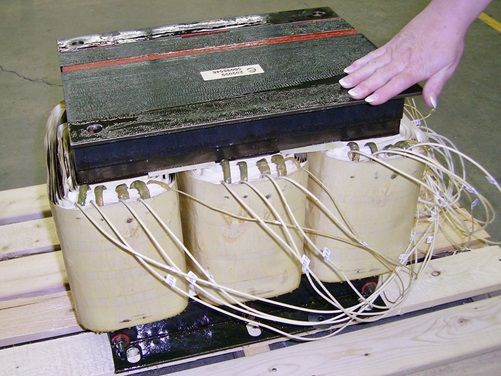
3 Phase Delta-Wye Transformer with Integrated Inductor
25.5KVA, 60Hz with 14.5mH: EI2.4" lamination, 12 Pulse Full Wave Rectified, Electrostatic Shield
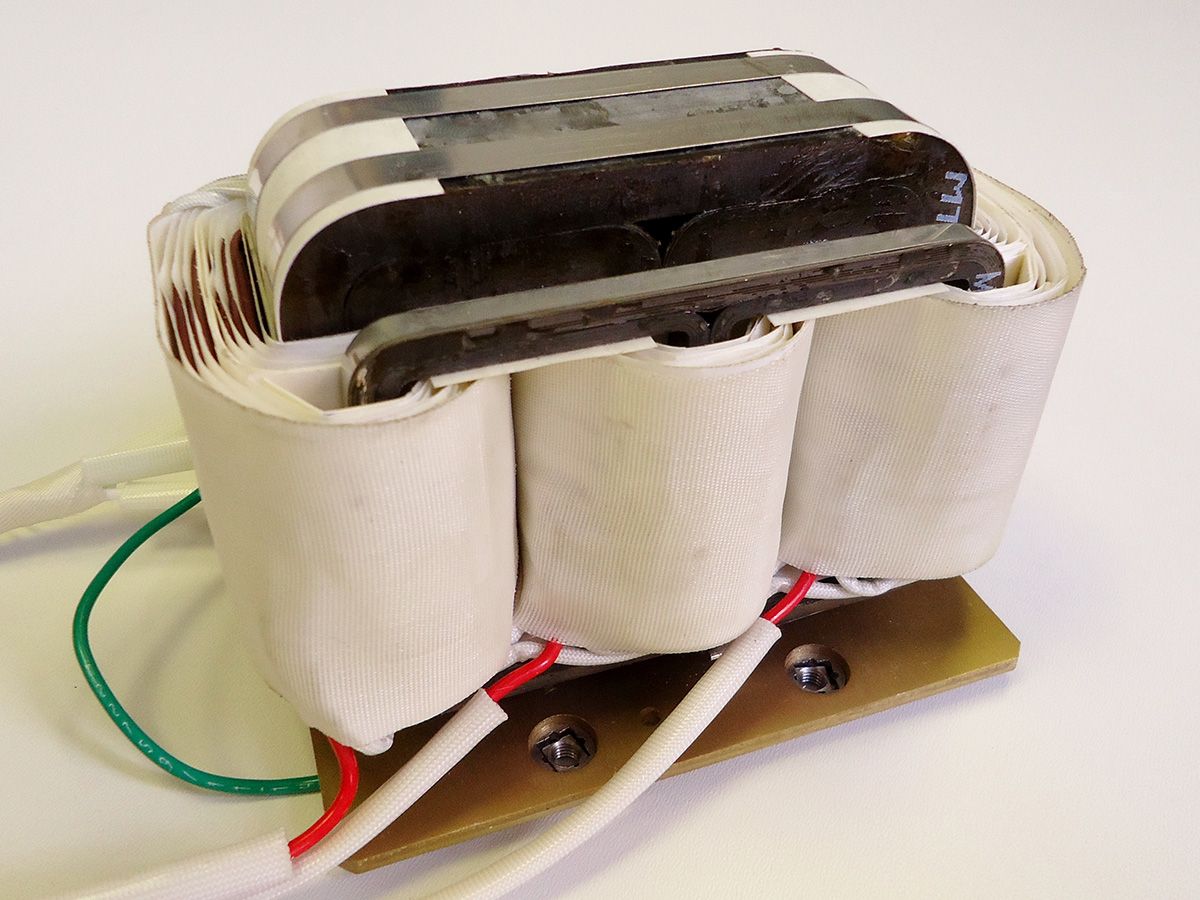
3 Phase Power Transformer with Integrated Inductor
9.0KVA, 400Hz with 100uH: Tape Wound E-Cores, Open Style, Electrostatic Shield; used in APU Power System.
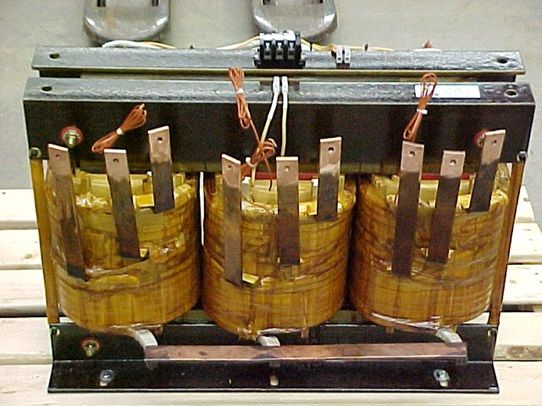
3 Phase Battery Charge Rectifier Transformer
35KVA, 60Hz: Open Style, Electrostatic Shield, M6 Grain Oriented Shunts, 6 Slot Chassis Mount
Reliable, Innovative Designs.
Each unit is assembled in-house with care and precision and delivered on time and within budget.
3 Phase and Multi Phase Transformer Capabilities at Electronic Craftsmen
-
Power: From mW to 50kVA @ 60Hz or up to 200kVA @ 20kHz (typical)
-
Working Voltage up to 12kV (depending on frequency); multiple stages possible for higher outputs
-
Frequency: 25Hz to 500kHz (typical)
-
Temperature Class to 220C (155C / Class F typical)
-
Weight: 0.06 oz / 1g to 550 lbs / 250kg
-
Multiple taps as required
-
Dielectric Strength (hipot) to 30kVac or 20kVdc
-
Parts can be vacuum varnished or molded with a variety of hard or soft encapsulant materials with thermal conductivity.
-
Wire sizes from 1-45 AWG or Copper Foil to 0.050in thick (in multiple layers for higher current); Litz wire for higher frequency
-
Regulation to specification
-
Manufactured using all known state-of-the-art magnetic core materials, including but not limited to electrical grade steel laminations, ferrites & powdered iron, nickel-iron alloy, iron amorphous metal strip-wound cores, nanocrystalline cores and small toroids.
-
Antifungal and non-nutrient coatings available
-
Corrosion resistant coatings & platings available
-
Standard or custom terminations & leads
-
Mounting Configurations: pcb-mount (horizontal or vertical), custom or standard brackets or stacked configurations
-
Designed to meet CSA & UL (safety) or MIL PRF 27 (aerospace / military) requirements upon request
-
MIL PRF 27 Grade 5 & 6 encapsulation available
FAQs
What are the common connection configurations (delta, wye) in 3-phase transformers, and why choose one over the other?
Delta (Δ) and Wye (Y, aka star) are typical winding connection types. For example, a delta-to-wye configuration (Δ primary, Y secondary) is common because it provides a neutral output on the wye side and ensures stable grounding and load balancing.
What are the advantages of using a 3 phase transformer over single phase units?
3 phase transformers are more compact, cost-effective, and efficient for delivering power in industrial environments. They handle higher loads with better voltage regulation and distribute power evenly across three lines, reducing electrical stress.
What applications typically require 3 phase power transformers?
Industries, commercial buildings, manufacturing plants, and power distribution systems use 3 phase transformers for running large motors, heavy machinery, HVAC systems, and high-voltage distribution because of their efficiency and balanced power delivery.
Can a 3-phase transformer be used for step-up or step-down voltage conversion?
Absolutely. A 3-phase transformer can be designed to step voltage up or down across three phases, just as single-phase versions do, but with attention to proper winding design, core sizing, insulation, and vector group selection to ensure phase alignment and performance.
Is there a “most common” 3-phase connection used in industry?
While usage varies by region and application, the delta-to-wye (Δ → Y) configuration is very common because it allows the secondary side to have a neutral point for grounding and single-phase loads, while the primary side may operate without a neutral.